
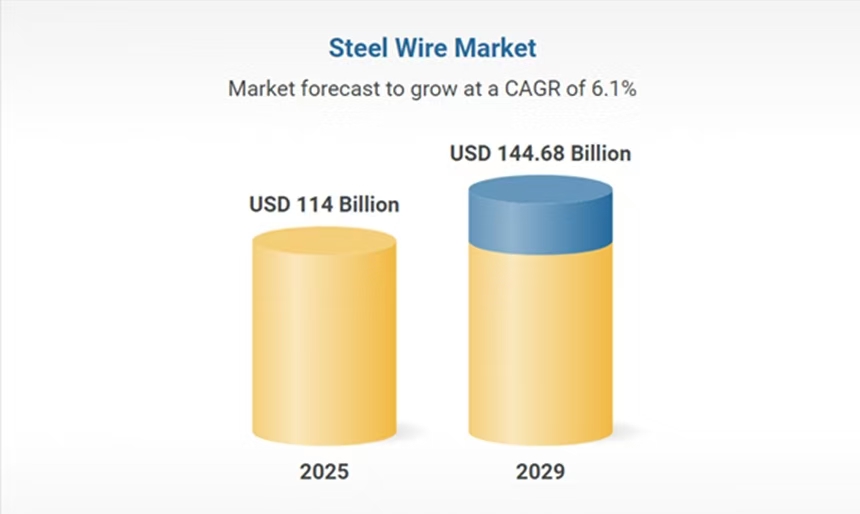
The steel wire market size is expected to see strong growth in the next few years. It will grow to $144.68 billion in 2029 at a compound annual growth rate (CAGR) of 6.1%. The growth in the forecast period can be attributed to increasing government investment in infrastructure around the globe, increasing demand for steel wire from various applications, increasing urbanization. Major trends in the forecast period include focus on strategic mergers and acquisitions, focus on launching new products, focus on investing in green hydrogen-based technologies and focus on artificial intelligence technology.
The forecast of 6.1% growth over the next five years reflects a modest reduction of 0.5% from the previous estimate for this market. This reduction is primarily due to the impact of tariffs between the US and other countries. This is expected to directly influence the US through limited imports of high-tensile wire products from Spain and China, potentially causing manufacturing bottlenecks for automotive and construction applications. The effect will also be felt more widely due to reciprocal tariffs and the negative effect on the global economy and trade due to increased trade tensions and restrictions.
The increasing demand for high-rise buildings is expected to drive the growth of the steel wires market. The structural systems of these buildings primarily utilize reinforced concrete and steel. Skyscrapers typically have a steel frame, while residential blocks are mostly constructed from concrete. In February 2024, Commercial Search, a US-based real estate agency, reported that around 475,000 multifamily units were completed in the U.S. in 2022, rising to over 500,000 units in 2023, with projections of nearly 736,000 units to be completed in 2024. Thus, the growing demand for high-rise buildings is contributing to the expansion of the steel wire market.
The rising demand for steel wire across various industries has fueled the growth of the steel wire market. Its increasing use in the construction, automotive, and aviation sectors is a key driver of this demand. Factors such as urbanization and the need for flexible, high-quality wire are further boosting steel wire consumption. Additionally, advancements in automobile performance, cost-effective production technologies, and improved manufacturing methods are expected to propel the market in the near future. The construction industry is the largest application segment for steel wire, with uses in road, river, and railway bridges, flyovers, atomic reactor domes, slabs, silos, hangers, aqueducts, high-rise buildings, viaducts, and railway sleepers. During the forecast period, demand for steel wire in these applications is anticipated to drive market growth. For example, in 2023, the Organisation Internationale des Constructeurs d'Automobiles (OICA), a France-based international association of automobile manufacturers, reported significant growth in the global automotive industry, with total vehicle production reaching 93,546,599 units - up from 85,016,728 units in 2022. Therefore, the increasing demand for steel wire is a major factor driving growth in the steel wire market.
The surge in government investment aimed at infrastructure development is a crucial driver for the growth of the steel wire market. Around the world, governments are dedicating significant resources to the construction sector, launching numerous infrastructure-focused programs that include the building of new roads, bridges, and suspension bridges. The demand for steel wire has notably risen in these construction projects, which seek to improve infrastructure and connectivity. Opportunities in the local construction market are substantial due to the demand for urban and rural infrastructure development. Restoration and reconstruction efforts are vital for reestablishing security and stability in affected areas. These investments not only help stabilize communities but also create job opportunities, benefiting those impacted by conflicts or disruptions. For instance, in September 2024, the US Census Bureau, a U.S.-based government agency, reported that construction spending was projected at a seasonally adjusted annual rate of $2.16 trillion in July 2024, representing a 6.7 percent increase (±1.8 percent) from the $2.02 trillion spent in July 2023. Additionally, total public construction rose to $270.8 billion in July 2024, up from $243.94 billion in 2023. Therefore, the increasing government investment in infrastructure development continues to be a driving force behind the growth of the steel wire market.
A prevalent trend in the steel wire market involves strategic mergers and acquisitions aimed at fostering innovation. Major players within this market are increasingly engaging in mergers and acquisitions with other industry counterparts. These collaborations are geared towards driving product innovation, gaining a competitive edge in the evolving steel wire market landscape, and exploring new geographical markets by leveraging shared skills and expertise.
In January 2022, Nippon Steel Corporation, a prominent steel-producing corporation, successfully acquired G Steel and G J Steel companies for an undisclosed sum. This strategic acquisition is anticipated to facilitate Nippon Steel's business expansion in the locally integrated market of Thailand and enable the company to cater to the demand for hot-rolled steel sheets. G Steel and G J Steel, the acquired companies, are based in Thailand and are recognized manufacturers in the steel industry.
Asia-Pacific was the largest region in the steel wire market in 2024. Europe is expected to be the fastest-growing region in the forecast period. The regions covered in the steel wire market report are Asia-Pacific, Western Europe, Eastern Europe, North America, South America, Middle East, Africa. The countries covered in the steel wire market report are Australia, Brazil, China, France, Germany, India, Indonesia, Japan, Russia, South Korea, UK, USA, Italy, Spain, Canada.
Note that the outlook for this market is being affected by rapid changes in trade relations and tariffs globally. The report will be updated prior to delivery to reflect the latest status, including revised forecasts and quantified impact analysis. The report’s Recommendations and Conclusions sections will be updated to give strategies for entities dealing with the fast-moving international environment.
The sharp rise in U.S. tariffs and the resulting trade tensions in spring 2025 are having a considerable impact on the construction sector, particularly in the areas of material procurement and overall project expenses. Increased duties on imported steel, aluminum, lumber, and machinery have raised costs for builders, contractors, and infrastructure developers, resulting in higher project bids and delays in execution. Manufacturers of construction equipment are also facing challenges, as tariffs on key components and raw materials are driving up production costs and compressing profit margins. Furthermore, retaliatory tariffs from major export markets have reduced demand for U.S.-made construction equipment and materials, putting additional pressure on revenue streams. In response, the sector is increasingly focusing on local sourcing, adopting modular construction methods, and diversifying supply chains to better manage rising costs and maintain project feasibility amid ongoing trade instability.
The steel wires market research report is one of a series of new reports that provides steel wires market statistics, including steel wires industry global market size, regional shares, competitors with a steel wires market share, detailed steel wires market segments, market trends and opportunities, and any further data you may need to thrive in the steel wires industry. This steel wires market research report delivers a complete perspective of everything you need, with an in-depth analysis of the current and future scenario of the industry.
Steel wires encompass steel products such as tubes and pipes derived from iron and steel, as well as shapes formed through the rolling or drawing of purchased iron or steel, and drawn steel wire. The manufacturing of steel wire involves producing various sizes, diameters, and strengths tailored for specific applications across different types of equipment.
The primary categories of steel wires include carbon steel, stainless steel, and alloy steel. Carbon steel, distinguished by a higher concentration of carbon compared to other steel types, is available in various thicknesses ranging from 0.01 to 0.8 mm, 0.8 mm to 1.6 mm, 1.6 mm to 4 mm, and 4 mm and above. These steel wires exist in different forms, including non-rope and rope. End-users of steel wires span across industries such as construction, automotive, energy, industrial, and others.
The steel wires market consists of sales of coated wire rope, stainless steel wire and galvanised steel wire. Values in this market are ‘factory gate’ values, that is the value of goods sold by the manufacturers or creators of the goods, whether to other entities (including downstream manufacturers, wholesalers, distributors and retailers) or directly to end customers. The value of goods in this market includes related services sold by the creators of the goods.
The market value is defined as the revenues that enterprises gain from the sale of goods and/or services within the specified market and geography through sales, grants, or donations in terms of the currency (in USD unless otherwise specified).
The revenues for a specified geography are consumption values that are revenues generated by organizations in the specified geography within the market, irrespective of where they are produced. It does not include revenues from resales along the supply chain, either further along the supply chain or as part of other products.
We Value Your Privacy.
Our website uses cookies to improve your experience. By clicking "Accept All Cookies", you agree to the storing of cookies on your device to enhance site navigation, analyze site usage, and assist in our marketing efforts.

 English
 日本語
日本語 한국어
한국어 français
 Deutsch
 Español
 italiano
 русский
 português
 العربية
 tiếng việt