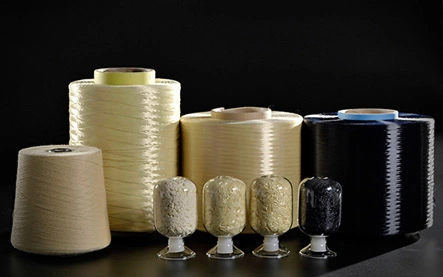
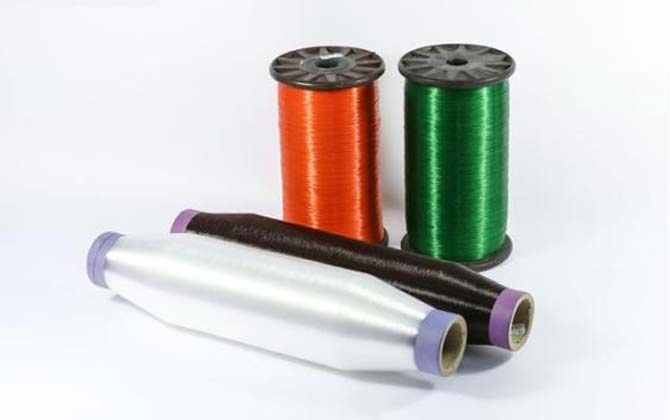
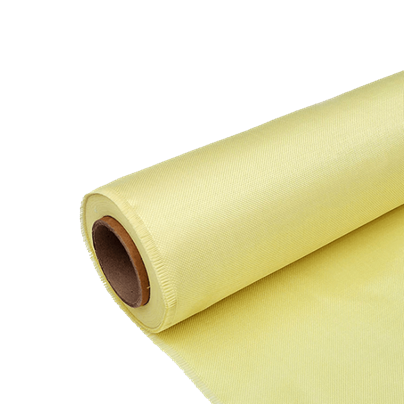
Para-aramid fibre is one of commonly used high-strength and high modulus fibres, which have good resistance to melt at high temperature. Even though such fabrics are sensitive to ultraviolet light (UV) but also have low affinity for water. Extremely strong and heat resistant aramids fibres are a class of synthetic fibres which introduced first by DuPont™ in the early 1960s. They are among the different polymeric fibres which is most recognized in the applications of protective systems. It is also constituted polyamides created from aromatic acids and amines.
Due to their strong adhesion between amide groups and aromatic groups, they could provide much better thermal resistance and traction compared with nylon fibres. Even though it is relatively expensive, fabrics made from such kind of fibres can provide high strength, high modulus and good tenacity, which are desirable properties for the ballistic applications. Due to these specific properties, they have increasingly replaced the Nylon fibres in military armor. Besides, the aramid materials also introduced the inherent flexibility and lightweight properties which could develop a comfortable ballistic vest along with excellent protective performances. Nowadays, these fibers are of the para-aramid type and marketed under the names Kevlar® and Twaron®.
Even though aramid made fabric provides a lighweight and better protection, the protecting solution design will be forced to reduce the number of fabric layers required without compromising the effectiveness of the final protecting armor to reduce the cost. In general, aramid fibers are 43 percent lighter than fibre glass (at density of 1.44 g/cc compared to 2.55 g/cc for fibre glass), twice as strong as E-Glass, ten times as strong as aluminium, same strength as of high strength carbon on a specific tensile strength basis. It is also display excellent dimensional stability with a slightly negative coefficient of thermal expansion (-2.4 × 10⁻⁶/°C) and could resist chemicals with the exception of a few strong acids and alkalis. Moreover, the aramids fibre exhibited an excellent stability over a wide range of temperatures for prolonged periods with, no strength loss at temperatures as low as −320 °F (−196 °C) and do not melt but will start to carbonize at approximately 800 °F (427 °C).
Kevlar® and Twaron® ((Teijin), are the two commonly used para-aramid materials in the development of bullet proof vests. The both are even five times stronger than steel but yet flexible. They are also heat resistant, cut resistant, chemical resistant, and can handle high ballistic impacts.
Technora (Teijin) is also another p-aramid fibre available with low creep, high melting point, and good abrasion and flexural resistance. Due to its early development, Kevlar® production has been refined significantly. The initial Kevlar® 29 was an innovative which makes the protective panels development not only more flexible and concealable but also provides a lightweight product that people were comfortably on an everyday basis. Later, in 1988 DuPont™ developed Kevlar® 129 for body armour use which significantly lighter than its predecessor with improved ballistic resistance capacities and can resist high-velocity rounds from guns such as the 9 mm FMJ. Moreover, the most recently released version of Kevlar® called Kevlar® Correctional (Introduced in 1995) could protects against knife and other weapon threats, and has led to the production of multi-threat vests that can halt both bullet and stab attacks. In general, based on their ballistic impact behaviour, the properties of para-aramids can be summarize as follows.
•Same compressive strength as E glass fibers
•Good resistance to abrasion
•Good chemical resistance
•Good resistance to thermal degradation (−42 °C to +180 °C)
•Excellent dimensional stability with a slightly negative coefficient of thermal expansion
•Constant high temperature stability
•Ballistic resistance restored to wet fibers after drying
We Value Your Privacy.
Our website uses cookies to improve your experience. By clicking "Accept All Cookies", you agree to the storing of cookies on your device to enhance site navigation, analyze site usage, and assist in our marketing efforts.

 English
 日本語
日本語 한국어
한국어 français
 Deutsch
 Español
 italiano
 русский
 português
 العربية
 tiếng việt